
Updated 4 October 2026 · Roadvault Transport, Nottingham
Try this first
A surprising number of these are really a flat battery. Modern automatics and electric handbrakes need power to release, so when the battery dies, the car locks itself in place.
- 01Check for powerIf the dashboard is dead or dim, it's probably the battery. A jump start often frees everything in a few minutes.
- 02Foot on the brakeMost automatics won't come out of park, and most electric handbrakes won't release, unless the ignition is on and the brake pedal is pressed.
- 03Look for the manual releaseMany automatics have a small shift-lock release near the gear selector, often under a cap. Your handbook shows where. Only use it on level ground, where the car can't roll away.
- 04Don't force itDragging a car with locked wheels damages the tyres, gearbox and brakes, and it's dangerous on a slope.
When it still won't move: recovery skates
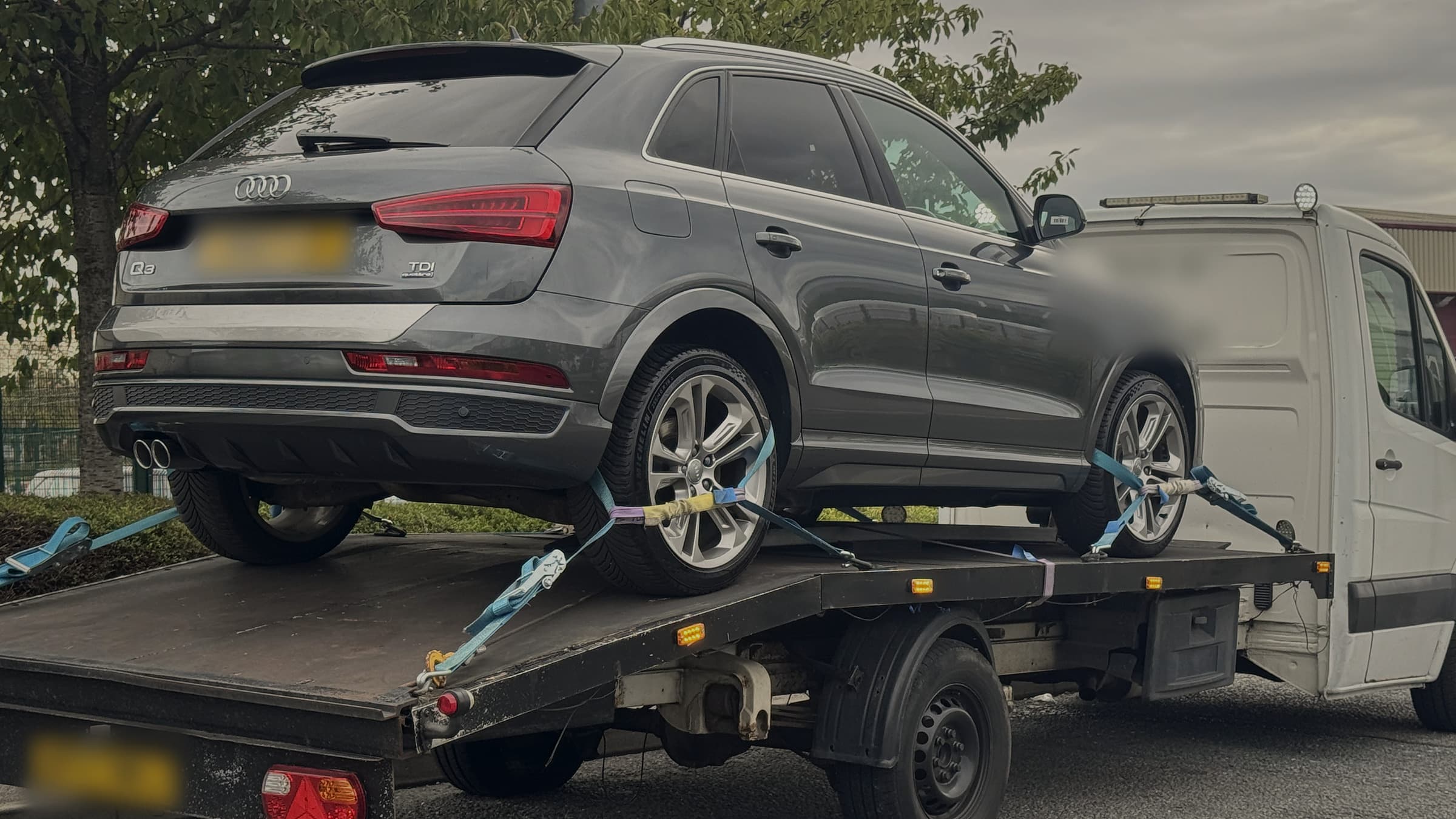
Recovery skates (sometimes called dollies) are small wheeled platforms that go under each locked wheel. They take the car's weight, so it can be rolled out of a tight spot and winched onto the recovery vehicle without turning a wheel.
We carry skates on our recoveries. They're only used if needed, the price is published (£40 for one or two wheels, or £60 for all four), and we'll always tell you before we use them. Skates get cars moving when:
- An automatic is stuck in park with a flat battery or a gearbox fault
- An electric handbrake has locked on and won't release
- A brake has seized after the car's been parked for a long time
- A wheel is damaged after a kerb strike or an accident
- The keys are lost, so the steering and gearbox stay locked
Cars with no keys
We can move a car without its keys, but we'll ask you to show it's yours first, usually the V5C logbook and photo ID with the same name and address. It protects you as much as us. If it's in a private or residential car park, tell us so we can arrange access.
Car parks, garages and tight spots
Multi-storey and underground car parks often have a height limit a recovery vehicle can't get under. Tell us the car park, the level and the height on the sign when you call. Often the car can be started where it is; if not, we'll talk you through moving it on skates to somewhere it can be loaded.